



Pr. Thierry Passeron: Skin and Exposome – What's known? What's new?
 Août. 2021
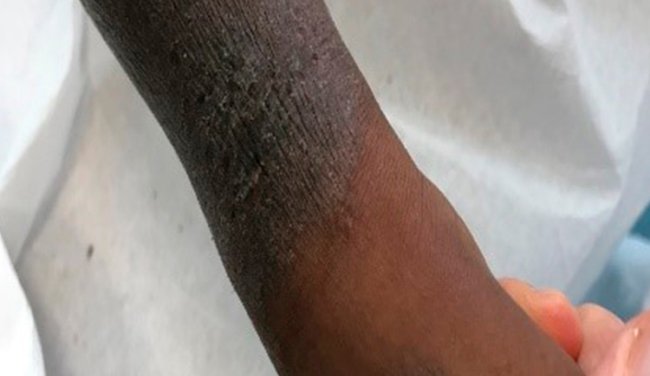
Clinical Presentation
Two parents and their three-year-old daughter came to the emergency dermatology services because their daughter had unbearable pruritis for a while that was developing with flare-ups, but never ones this acute. The family emigrated from Africa and recently settled in Italy. The father explains that in Africa, his daughter had “slight dermatitis” without further details, but that the dermatitis worsened when the family arrived in Europe.
Social History
The family recently moved to Italy from an unspecified African country. The mother accompanying her daughter only speaks her native language. The father speaks some French. With difficulty, we attempted to find out the history of the disease and treatment, but the information was hard to obtain because of the language barrier.
Physical Examination
The physical exam showed that the girl is in good health overall, but because of incessant scratching of her whole body, she has significant lichenification very visible on the limbs that were easiest to scratch. A more attentive examination of the skin revealed that the parts she did not scratch were lighter and chestnut coloured, while the scratched skin was darker and greyish-black. It was a case of erythema on dark skin.
Developments
Once they arrived in Italy, the parents began treating their daughter with a recipe frequently used in their home country to treat skin irritation: a mix of aloe vera pulp with olive oil in unknown proportions using ingredients with unknown qualities and origins. The parents were invited to bring this preparation in for analysis and observation.
Diagnosis
The disease is very inflammatory and itchy. The young girl developed either irritant contact dermatitis or allergic contact dermatitis aggravating her atopic dermatitis.
Management and outcome
Suspending this treatment led to a rapid improvement in symptoms.
At the control visit, the young girl had healed even if we could note minimal signs of atopic dermatitis as is normal with that condition.
Teaching points
The application of topical preparations containing olive oil and aloe vera with no standardisation of composition or concentrations of ingredients and which may include other ingredients not listed exacerbated the atopic dermatitis. This type of “do-it-yourself” treatment exposes patients to this type of complication. The use of active products mixed without compatibility studies and without following rules for dilution expose patients to harmful effects.
Bibliography