


Considerations and Tips for Promoting Skin Barrier
Maintenance and Quality of Life in Patients With
Diabetes Mellitus: An Expert Consensus
 Mar. 2026
In brief
Seborrheic Dermatitis (SD) and dandruff share many common features such as itchy, flaking skin. Half of the adult population suffers from either SD and/or dandruff. The presence and abundance of Malassezia yeast, host epidermal conditions and sebaceous secretion determine an individual’s susceptibility to SD and dandruff. Effective management of SD and dandruff requires clearing of symptoms with antifungal and anti-inflammatory treatment, improving associated symptoms and general scalp and skin health to help maintain remission.
Introduction
Seborrheic Dermatitis (SD) and dandruff are of a continuous spectrum of the same disease. Half of the adult population suffers from either SD and/or dandruff. Various intrinsic and environmental factors, such as sebaceous secretions, skin surface fungal colonization and individual susceptibility contribute to their pathogenesis.
SD is common and is neither contagious nor fatal. It involves flaking, scaling, inflammation, pruritus and marked erythema, affecting the scalp, the face, the retro-auricular area and the upper chest. Its incidence peaks during the first three months of life, puberty and adulthood. SD affects men more often than women and is more prevalent in immune-compromised patients (HIV/AIDS patients, organ transplant recipients, patients with lymphoma). Dandruff is more common. It involves itchy, flaking skin without visible inflammation, affecting the scalp. It starts at puberty, reaches peak incidence and severity at the age of about 20 years and becomes less prevalent among people over 50. Dandruff affects men more often than women.
Clinical presentations
SD often presents as well-delimited erythematous plaques with symmetrical distribution, with flaky, large, oily or dry scales in regions rich in sebaceous glands, such as the scalp, the retro-auricular area, face (nasolabial folds, upper lip, eyelids and eyebrows), the upper trunk, lower extremities and upper extremities. Pruritus is often present. Secondary bacterial infection due to skin excoriation may occur and cause from superficial impetiginisation to soft tissue infection (erysipelas).
Dandruff presents light, white to yellow and dispersed flaking on the scalp and hair without erythema, which can spread to hairline, retro-auricular area and eyebrows.
Pathophysiology
The presence and abundance of Malassezia yeast, host epidermal conditions and sebaceous secretion determine an individual’s susceptibility to SD and dandruff (figure 1). Predisposing factors and their interactions in the pathogenesis of seborrheic dermatitis and dandruff.
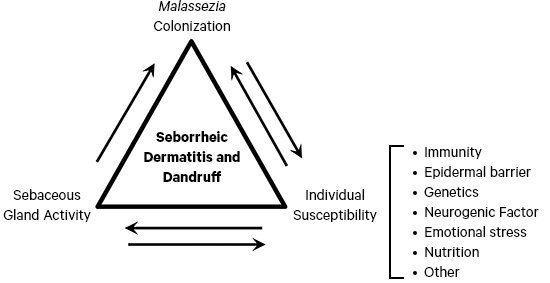
Figure 1. Predisposing factors and their interactions in the pathogenesis of seborrheic dermatitis and dandruff.
Fungal colonization
Malassezia, lipophilic yeasts found on seborrheic regions of the body, are believed to play a key role in SD and dandruff. Malassezia are found on the scalp of dandruff patients and higher numbers of Malassezia (M. globosa and M. restricta) correlate with SD appearance/severity. Malassezia metabolises sebum resulting in oxidized proinflammatory metabolites that can lead to disrupted epidermal barrier function and trigger inflammatory response, with or without visible local inflammation.
Sebaceous gland activity
SD and dandruff have a strong time correlation with sebaceous glands activity. Sebum production is under hormonal control and secretion of sebum is highest on the scalp, face and chest. Sebum influences intercellular lipid organization and skin barrier integrity. Increased sebum production leads to a favorable environment for Malassezia growth. Abnormalities of lipid composition, especially under the influence of Malasseziaplay a role in SD development.
Individual susceptibility
Other factors such as epidermal barrier integrity or host immune response have been shown to play a role in individual susceptibility.
Treatment
The most common treatment of SD and dandruff is the use of topical antifungal and anti-inflammatory agents (mainly topical steroids). Treatment allows clearing signs of the disease; ameliorating associated symptoms, especially pruritus; As dandruff and SD are chronic relapsing conditions, prolonging remission with maintenance regimens is of high importance. Efficacy, side effects, ease of use/compliance and age of the patient must be considered before treatment selection.
Conclusion
Seborrheic dermatitis and dandruff share many common features and respond to similar treatments. Effective management of SD and dandruff requires clearing of symptoms with antifungal and anti-inflammatory treatment, ameliorating associated symptoms such as pruritus, and general scalp and skin care regimens to help maintain remission.
Reference
Borda LJ, Wikramanayake TC. Seborrheic Dermatitis and Dandruff: A Comprehensive Review. J Clin Investig Dermatol. 2015 Dec;3(2).
Mar. 2026 Jun. 2025