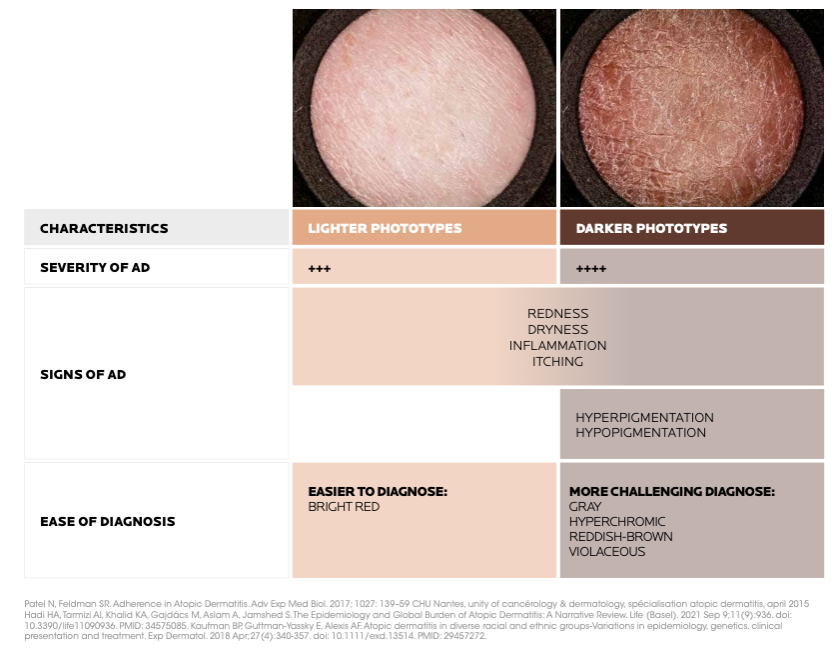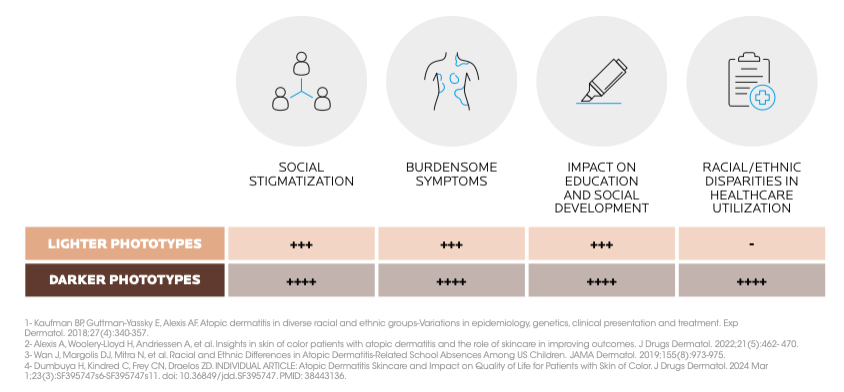

Atopic dermatitis (AD) is the most common chronic inflammatory skin disease causing itchiness. It is characterized by a damaged skin barrier, a skin inflammation, and an imbalanced skin microbiome. As for the visible signs, redness, erythema and scaly patches are most common. Even in patients with a typical distribution and morphology of lesions, the appearance of AD varies based on skin color. Unfortunately, skin of color (SOC) patients are under-represented in dermatology and in AD clinical trials. This may impact clinicians’ ability to diagnose AD in patients of colour (1,2,3).


1 - Hirano SA, Murray SB, Harvey VM. Reporting, representation, and subgroup analysis of race and ethnicity in published clinical trials​ of atopic dermatitis in the United States between 2000 and 2009. Pediatr Dermatol. 2012;29(6): 749-755.
2 - Chatrath S, Bradley L, Kentosh J. Dermatologic conditions in skin of color compared to white patients: similarities, differences, and special considerations. Arch Dermatol Res.2023;315(5):1089-1097.
3 - Sevagamoorthy A, Sockler P, Akoh C, et al. Racial and ethnic diversity of US participants in clinical trials for acne, atopic dermatitis, and psoriasis: a comprehensive review. J Dermatolog Treat. 2022;33(8):3086-3097.

FACTORS CONTRIBUTING
TO AD DIFFERENCES

AD IN LIGHTER AND DARKER PHOTOTYPES
HOW DOES IT MANIFEST?


IMPACT OF AD ON THE QUALITY OF LIFE