Psoriasis is an inflammatory dermatosis characterized by erythematous-squamous lesions that have a chronic relapsing course. The disease is genetically determined and has an autosomal dominant and multifactorial polygenic mechanism with varying penetrance. It is characterized by chronic inflammation of likely autoimmune nature. Anomalous activation and migration of T lymphocytes, as well as altered production of cytokines, lead to pathological changes in keratinocytes. This results in chronic inflammation and increased turnover of the epidermis.
Factors that can contribute to the development of psoriasis include trauma, infections, stress, and certain medications such as beta-blockers and lithium. The condition is more common in Caucasians, with an incidence in the general population ranging from 0.1% to 3%. Psoriasis can occur in individuals of all ages, although it is more commonly observed in young adults. There are no significant differences in occurrence between sexes. In children, the prevalence of psoriasis gradually increases with age, affecting 10% of cases under 10 years old and only 2% of cases under 2 years old.
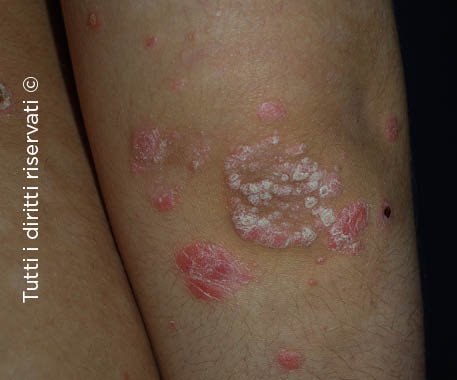
Psoriasis presents as well-defined, raised patches of red skin covered with dry silvery scales. These patches are typically large with geometric or polycyclic shapes. As the lesions resolve in the center and extend outward, circular or figurative elements may form. Removing the scales may cause pinpoint bleeding (Auspitz sign). During active phases of the disease, Koebner's sign or reactive isomorphism may be present, where new psoriasis patches develop on previously injured skin. Commonly affected areas include the elbows, knees, scalp, and back. The number of lesions can vary, and they are usually bilateral and symmetrical. In children, the scales may be thinner and only partially cover a less intense redness. Additionally, psoriasis can affect the face and scalp, ranging from a few patches to widespread involvement of the entire scalp with dry scales on a non-exuding red base. The nails can also be affected, with symptoms such as pitting, salmon-colored patches, onycholysis, and subungual hyperkeratosis. Psoriatic nail involvement can be associated with arthritis. The onset of psoriasis can be either acute or gradual, and the disease typically lasts for months or years. Overall, general health is usually unaffected, even after years of relapses. General symptoms are rare, and subjective symptoms are minimal, although itching is not uncommon in children. The course of psoriasis can vary, but it tends to persist or relapse even after long periods of remission. Improvement is often seen during the summer months.
Atypical forms of psoriasis can present with different morphologies and locations.
Guttate psoriasis is commonly seen in children and often follows an infectious episode such as tonsillitis.
In the follicular form, scaly papules appear with localization around hair follicles.
Inverted psoriasis tends to affect skin folds, particularly the intergluteal fold, inguinal folds, genital region, and navel. It presents as red patches with a shiny surface, typically without a significant scaling component.
The pustular form of psoriasis can occur at the onset or develop from a plaque form following systemic or, less commonly, local steroid treatment. There are localized and generalized forms. The generalized form is characterized by fever, general malaise, and the appearance of erythematous-scaly patches that develop non-follicular miliary pustules within a few days. It can affect the entire skin surface (erythroderma). The pustules eventually dry up and become flaky. The evolution of this form is cyclical, with subsequent flare-ups occurring every 3-4 weeks.
Erythrodermic psoriasis may be present at birth or develop later, often as a complication of pre-existing psoriasis.
Napkin psoriasis occurs in the diaper area as a worsening of pre-existing dermatitis. It appears bright red and congested and is accompanied by psoriasiform patches on the trunk, limbs, and face. It typically occurs after the third month of life and can recur up to the third year. It is considered an indicator of psoriasis, as there is an increased risk of developing the disease in the following years (5% of cases within the next 10 years).
Psoriasiform acral dermatitis is a pattern of psoriasis that affects the hands. It presents with psoriasiform lesions on the palmar surface and scleroderma-like lesions on the dorsal area, resulting in thin and shiny skin. It can be associated with psoriatic nail involvement and typical lesions in other locations. This manifestation is not very responsive to therapy and tends to resolve around puberty.
Sometimes, both eczema and psoriasis can be observed in the same individual. This form is known as psoriasis-dermatitis and is characterized by the presence of psoriatic patches associated with flexural eczema. There may be a positive family history for both diseases.
Arthropathic psoriasis is a seronegative form that often affects the extremities and occurs in association with the dermatosis. It has a relatively typical radiological appearance. Approximately 5-7% of psoriasis patients also have psoriatic arthritis. Children are rarely affected. Psoriatic arthritis can precede or follow the onset of psoriasis, and in approximately 10% of cases, both conditions appear simultaneously. Childhood psoriasis generally has a better prognosis than adult psoriasis, with spontaneous remission occurring in over one-third of cases. Only 30% of cases continue to have lesions beyond 15 years of age. Additionally, the clinical presentation of psoriasis can change over time in children.
Psoriasis has been associated with comorbidities such as obesity, metabolic syndrome, cardiovascular diseases, psychiatric disorders (with an increased risk of developing depression, anxiety syndrome, and bipolar disorders), chronic inflammatory bowel disease, celiac disease, and psoriatic arthritis. Therefore, the care of children with psoriasis should include periodic checks to identify any associated extracutaneous pathologies. The most commonly used severity scores for psoriasis are the PASI (Psoriasis Area and Severity Index), DLQI (Dermatology Life Quality Index), and PGA (Physician Global Assessment). However, these scores are challenging to use in children. In severe pediatric cases, systemic therapy is considered when topical treatments fail, following the "rule of ten": BSA >10%, PASI >10, or DLQI >10. The diagnosis of psoriasis is primarily clinical, and in cases of doubt, a histological examination may be performed. Differential diagnoses include lichenoid pityriasis or guttate parapsoriasis, pityriasis rosea, dermatomyositis, and seborrheic dermatitis. Treatment options for psoriasis in children include topical products for mild to moderate forms and systemic therapies for more severe cases. Topical drugs commonly used in pediatric patients include corticosteroids, vitamin D analogues (calcipotriol, tacalcitol, calcitriol), calcineurin inhibitors, and retinoids (tazarotene), often in combination with emollients. Phototherapy with UVBTL01 can be used for widespread lesions. In severe cases, biologics such as adalimumab (over 4 years), etanercept (over 6 years), and ustekinumab (over 12 years) are approved according to guidelines. Acitretin, methotrexate, and cyclosporine A, although commonly used, are off-label for this age group.