




Symptoms/signs
65-year-old male patient.
The patient reports the onset of widespread lesions on his torso, associated with intense itching about two months ago, one month after starting therapy.
Patient photographs
Clinical presentation
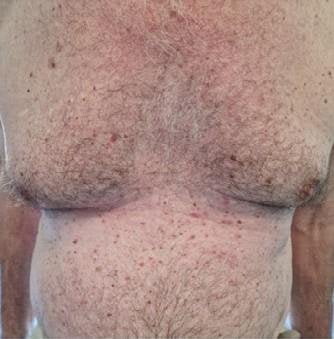
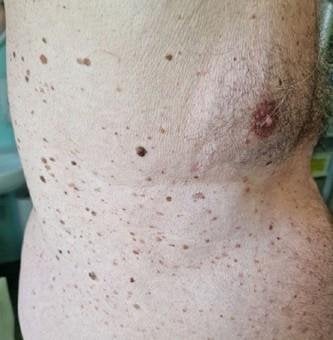
A symmetrical and generalised rash of purplish erythematous papules is observed, mainly affecting the torso. The mucous membranes are unaffected, as are the flexor surfaces of the forearms, which are typical sites of idiopathic lichen planus.
Medical history
Adenocarcinoma (NSCLC, non-small cell lung cancer) of the right lung was diagnosed in June 2022. Following the diagnosis of advanced disease and positivity for anaplastic lymphoma kinase (ALK), therapy with crizotinib, an ALK tyrosine kinase inhibitor, was initiated approximately three months prior to the dermatological assessment. About one month after the start of treatment, the patient reported the appearance of skin side effects.
Differential diagnosis
Exanthematous rash
Lichenoid rash
Psoriatic rash
Diagnostic tests
The skin biopsy, performed on a lesion on the patient’s back, revealed findings compatible with an interface lichenoid dermatitis and an infiltrate composed of eosinophils and plasma cells, indicative of an iatrogenic aetiology.
The clinical presentation and histological findings in this case enable differentiation between idiopathic lichen planus and a drug-induced lichenoid rash. It was therefore concluded that this was a lichenoid rash likely induced by cancer treatment with crizotinib.
Description of the disease
Drug-induced lichenoid (or ‘lichen planus-like’) rashes are associated with a wide range of therapeutic agents, including kinase inhibitors and immunotherapies in oncology, and may occur many months after the start of treatment. Skin lesions are often less specific, with an eczematous or psoriasiform appearance, and are more generalised than idiopathic forms of lichen planus. A photodistributed rash may also occur in combination with certain drugs, such as thiazide diuretics. Finally, hyperpigmentation is a very common and sometimes persistent consequence.