




Symptoms/signs
60-year-old female patient.
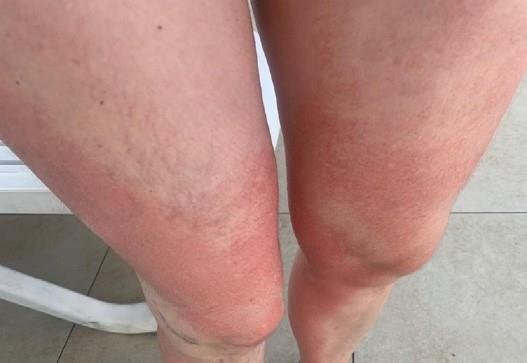
The patient reports the onset of a rash over her neckline, face and limbs, shortly after sun exposure, in summer, 6 months after starting therapy.
Patient photographs
Clinical presentation
Physical examination of the skin reveals erythema on the neckline, face and lower limbs, with a clear boundary around the areas exposed to sunlight. An erythematous-bullous lesion is also observed on her lower lip.
Medical history
In 2012, she was diagnosed with stage IIIC ovarian cancer. The patient is currently being treated with rucaparib, a small oral molecule that inhibits the Poly(ADP-ribose) polymerase-1 (PARP) enzyme.
Differential diagnosis
Drug-induced phototoxic reaction
Drug-induced photoallergic reaction
Photoaggravated dermatitis
Diagnostic tests
The association with sun exposure and involvement clearly limited to sun-exposed areas suggest a drug-induced phototoxic reaction. In this case, the patient did not undergo a skin biopsy for diagnostic purposes. A histological examination would show necrosis of keratinocytes in the epidermis and vasodilation, oedema in the dermis, with scarce inflammatory infiltrate. Finally, photoallergic testing may be considered when cell-mediated immune pathogenesis is suspected.
Description of the disease
Phototoxic drug reactions are often caused by molecules with ring-shaped chemical structures. The clinical presentation looks like sunburn and occurs shortly after exposure in a dose-dependent manner, both concerning the drug and ultraviolet rays. Such reactions are commonly observed in dermatology, while some manifestations of phototoxicity, such as photoonycholysis and pseudoporphyria, are rarely observed.
In addition, photoallergic rashes are usually associated with drugs containing a sulphuric group, are not dose-dependent, and the skin involvement extends beyond the directly exposed areas.