




Symptoms/signs
70-year-old male patient.
The patient reports dryness and scaling of the hands, which has been present for
a long time and worsened about 1 month ago, following the change in cancer therapy. He complains of tenderness in his hands, particularly on his palms.
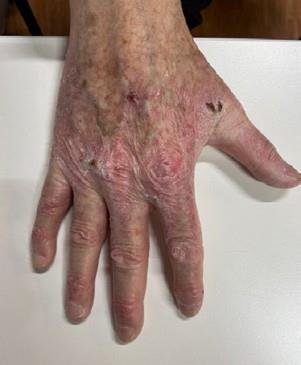
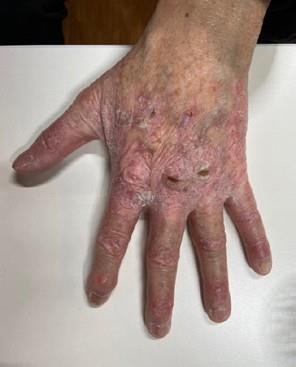
Patient photographs
Clinical presentation
Symmetrically distributed, dark red, scaly erythematous patches are observed on the hands with fairly clear edges. In this context, fissures and serous-haemorrhagic scabs are observed, accompanied by significant xerosis.
Medical history
The patient suffers from diabetes mellitus and is on oral antidiabetic therapy, complicated by arterial hypertension.
In July 2010, he was diagnosed with polycythaemia vera, for which he was treated with phlebotomy and, since 2021, with oncocarbide. In December 2022, he presented with right lateral malleolar ulcer and erythrocyanosis on three toes, for which oncocarbide was discontinued and therapy was started with busulfan, an alkylating molecule belonging to the alkyl sulphonate group, at a dosage of 2 tablets of 2 mg per day. Given platelet count of 1,010,000 cells per microlitre, low-dose aspirin 100 mg 1 tablet per day was prescribed.
Differential diagnosis
Acral erythema induced by chemotherapy
Secondary erythromelalgia
Inflamed actinic keratosis
Diagnostic tests
Secondary erythromelalgia may be associated with myeloproliferative and myelodysplastic disorders (usually essential thrombocythaemia and, less frequently, polycythaemia vera) when platelet counts are elevated. Since the pathogenesis is mediated by platelets, this condition responds to the administration of acetylsalicylic acid.
Long-term therapy with hydroxychloroquine has been associated in literature with the induction of keratinocyte neoplasms, particularly squamous cell carcinomas and actinic keratoses. Therefore, in this subject with skin type II and chronic actinic damage, clinical and dermatoscopic examination was performed to rule out the presence of formations requiring surgical excision or skin-directed treatment.
Description of the disease
Acral erythema induced by chemotherapy (also described as “erythrodysaesthesia” and “hand-foot syndrome”) is a common reaction to many chemotherapy drugs and targeted therapies. Manifestations can occur days to months after initiation of chemotherapy and begin about 2 to 4 weeks after taking molecular targeted agents. The reaction may affect the hands and/or feet, and symptoms range from a sensation of dysaesthesia to a burning pain. Nail changes are often associated with this condition. Diabetes is a risk factor that may predispose the patient to acral erythema.