




Symptoms/signs
75-year-old female patient.
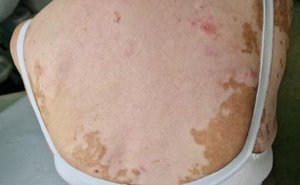
The patient reports widespread patches of depigmentation, which appeared three months after the start of treatment without any associated symptoms, and are slowly spreading.
Patient photographs
Clinical presentation
Patches with clear, irregular convex edges showing complete depigmentation are observed on the torso and limbs.
Medical history
In 2020, she was diagnosed with nodular melanoma of the head, ulcerated and 2.4 mm thick according to Breslow. Subsequent staging revealed stage IV disease; furthermore, BRAF mutational analysis of the primary tumour did not reveal the V600E mutation, which would indicate targeted therapy. Therefore, therapy with nivolumab, PD-1 checkpoint inhibitor, was initiated at 240 mg every two weeks.
Differential diagnosis
Melanoma-associated leukoderma
Vitiligo-like lesions related to cancer immunotherapy
Generalised vitiligo
Pityriasis versicolor
Diagnostic tests
Observation of areas of complete pigment loss, together with the patient's medical and pharmacological history, guide the diagnosis in this case.
Description of the disease
The appearance of vitiligo-like skin lesions in subjects with melanoma is considered to be the manifestation of an anti-cancer immune response, which may be spontaneous or induced by treatment. Melanoma-associated leukoderma (cutaneous or ocular) refers to depigmentation in the context of neoplasia (regression), in the surrounding area (halo phenomenon) or at a distance from the primary melanoma. The response to immunotherapies for melanoma, with monoclonal antibodies against CTLA-4 (cytotoxic T-lymphocyte-associated antigen-4) and PD-1 (programmed cell death-1), has been associated with vitiligo-like lesions in many cases.
Pharmacological treatment and patient instructions
It is believed that the appearance of vitiligo-like manifestations during immunotherapy may confer a survival advantage in patients with metastatic melanoma. Although treatment is not usually required, pharmacological management of this condition has been proposed in case reports in literature, with topical immunomodulators (corticosteroids or JAK inhibitors) or with narrowband UVB phototherapy.
Dermocosmetic management
Management relies on education on how to use corrective camouflage to conceal this manifestation and reduce its impact on daily quality of life.
Follow-up (adjuvant treatment outcomes)
At the 2-month follow-up visit, the skin condition was observed to be substantially stable with a persistent response to the ongoing cancer treatment. In any case, a high protection-factor sunscreen is required and should be applied to all exposed areas, at most every two hours of outdoor activity.