




Symptoms/signs
70-year-old female patient.
Ten days after starting radiotherapy, she complains of itching and burning on the skin of her right breast.
Patient photographs
Clinical presentation
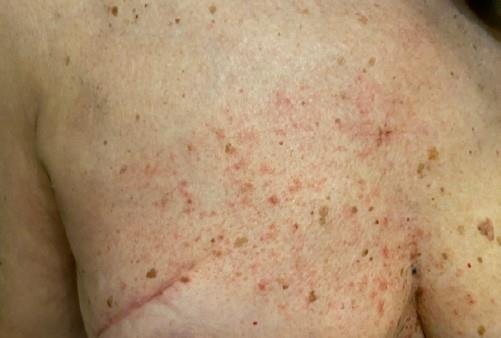
A physical examination of the skin revealed erythema and scaling on the upper and medial surface of the right breast, corresponding to the radiation field.
Medical history
In August 2022, the patient underwent right upper-outer quadrantectomy and sentinel lymph node biopsy with a diagnosis of grade 2 lobular breast cancer; the sentinel lymph node was free of metastasis. Adjuvant radiotherapy was planned for December 2022 on the right breast for a total dose of 40.5 Gy in 15 fractions. At the same time, additional hormone therapy with letrozole was initiated.
Differential diagnosis
It is important to determine the severity of the acute radiation dermatitis.
Grade 1: mild-to-moderate erythema at the radiation site, dry peeling, moderate skin sensitivity
Grade 2: mildly painful erythema, moist lesions in skin folds, oedema
Grade 3: intense and painful red erythema, serous lesions extending beyond the fold regions, bleeding
Diagnostic tests
Collaboration between the radiotherapist and dermatologist is desirable for rapid recognition and optimal management of acute radiation dermatitis, as this can negatively affect quality of life and tolerability of the therapy itself.
Description of the disease
Acute radiation dermatitis occurs about 10 to 14 days after radiation therapy given with commonly used fractionation patterns (2 Gy/fraction). Normally, healing occurs after an additional 14 to 21 days, approximately. It should be noted that the most susceptible areas are skin folds – those under the breasts, armpits and clavicle – as well as the groin area, mucous membranes and skin weakened by previous treatments. The skin is a tissue that is sensitive to radiation damage because it is an organ that is constantly replicating: the cell death of basal keratinocytes due to acute radiation damage causes the destruction of barrier integrity.