


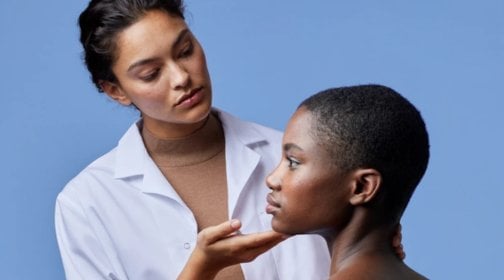

The skin is the largest organ in the body, the most exposed to contact with others, and it is the covering that contains and protects our body. Therefore, the skin is both our calling card to the world and a litmus test of our inner state.
Today, it is known that the nervous system and skin have the same embryonic origin: they are closely related, with preferential communication channels thanks to the action of certain shared chemical mediators; emotional and psychological aspects can affect the condition of the skin and vice versa.
A physiological or pathological process affecting the skin can alter the way an individual relates to others: skin conditions such as acne, psoriasis, atopic dermatitis and alopecia are often associated with depression, partly because they are long-term, chronic conditions.
The link between the psyche and the skin is very important for both women and men: it is essential that doctors always pay attention to aesthetic aspects, in order to understand how patients see themselves and how they experience any discomfort caused by skin disorders.
The camouflaging of lesions exposed to the gaze of others arises precisely as a form of “rebalancing” between the inner and outer worlds.
Camouflage is not only used to “hide” blemishes, but also to “smooth out” a face that is tired due to chemotherapy treatments or to rebalance facial asymmetries due to paralysis.
People who feel different or are atypical are compelled to set in motion positive mechanisms that make them interesting, according to criteria of originality and freedom.
ADDITIONAL ADVICE
To complete the camouflage, or in cases where make-up cannot be used to conceal skin conditions, attention should be paid to selecting clothing and accessories according to colour harmony criteria.
Colour harmony helps because it teaches you to discover your “friendly colours” and how to use them to your advantage, to enhance the positive features of your face and thus divert attention away from imperfections caused by medical problems.
In general, colour harmony is based on repetition of one's personal characteristics: “skin temperature”, or undertone, value, colour contrast and intensity.
When you want to tone down a feature, you act on contrast. Therefore, in the event of redness, solid colours such as blue, green, and purple are preferred. In the case of vitiligo or other types of discolouration, avoid patterns such as polka dots, small flowers, spotted prints or any other design that visually recreate the image of the imperfection you are trying to conceal. It would therefore be advisable to opt for plain colours, and the same applies to glasses, so spotted frames are not recommended.
In addition, colour contrasts can be used to draw the observer’s attention to a focal point created by the meeting of two colours, thus diverting attention away from the skin.
There are many small steps you can take to regain control of yourself and your appearance.